A transit IC card is the single most useful thing you can carry in Japan. It is a contactless card — or an entry in your phone's wallet — that you touch to a reader to pay a train fare, a bus fare, or a convenience store bill. There is no app to open, no PIN, no signature, and no need to work out what a journey costs before you take it.
This guide covers what the cards are, which one to get, where each is accepted, how to put one on your phone, and the handful of rules that catch visitors out at the ticket gate.
What is an IC card?
IC stands for "integrated circuit". The card holds a chip and an antenna, and a reader powers it wirelessly for the fraction of a second it takes to complete a transaction. Japan's cards use Sony's FeliCa standard rather than the contactless system used by most bank cards elsewhere, which is why the readers are so fast — and, as covered below, why not every phone can hold one.
What matters practically is that the card is a stored-value purse. You load money onto it, and each tap deducts from that balance. It is not linked to a bank account, it is not a credit card, and an anonymous card is not tied to your identity in any way. If you lose an unregistered card, you have lost the balance exactly as if you had dropped cash.
Why use one?
Paper tickets still exist, and for a single journey they are not difficult. The case for a card is what happens across a whole trip.
- No fare calculation. Japanese fares are distance-based, so a paper ticket means finding your destination on a fare map — often in Japanese — and buying the right value before you travel. A card works it out on the way out.
- One payment method across operators. A typical Tokyo journey can involve a JR line, a subway run by a different company, and a private railway. The card settles all of it without you knowing where one network ends.
- It works on buses, where paying cash means having coins and understanding a numbered-zone fare display.
- It is also money. Convenience stores, vending machines, and coin lockers take the same tap.
- Fares are marginally cheaper. IC fares are calculated to the yen, while paper tickets round up to the nearest ten. The saving is trivial per journey and real over two weeks.
- Nothing to lose. No ticket to keep hold of between the gate and the platform.
Where IC cards work
Coverage is broad in cities and thins out in the countryside.
| Where | Accepted? |
|---|---|
| JR lines in and around the major cities | Yes |
| Subways in Tokyo, Osaka, Kyoto, Nagoya, Sapporo, Fukuoka and others | Yes |
| Private railways in the big metropolitan areas | Yes |
| City buses in most large cities | Yes |
| Convenience stores, drugstores, many supermarkets | Yes |
| Vending machines and station coin lockers | Yes |
| Many taxis, cafés, and fast-food chains | Usually |
| Shinkansen and limited express services | No — needs its own ticket |
| Rural buses and some local railways | Often not |
| Long-distance journeys crossing a fare area | No — see below |
Look for a 交通系IC ("transit-type IC") sticker at a till, or the logo of any of the ten cards. Any one of them means all ten are accepted.
The major IC cards
Ten cards have been mutually accepted since 2013. In practice a visitor will meet Suica, PASMO or ICOCA, and any of the three will serve for an entire trip.
| Card | Issuer | Home region | Tourist version | In a phone |
|---|---|---|---|---|
| Suica | JR East | Tokyo and eastern Japan | Welcome Suica | Yes |
| PASMO | Tokyo private rail and bus | Greater Tokyo | — | Yes |
| ICOCA | JR West | Osaka, Kyoto, western Japan | — | Yes |
| PiTaPa | Kansai private operators | Kansai | — | No |
| TOICA | JR Central | Nagoya and central Japan | — | No |
| manaca | Nagoya rail and bus | Nagoya | — | No |
| Kitaca | JR Hokkaido | Sapporo and Hokkaido | — | No |
| SUGOCA | JR Kyushu | Fukuoka and Kyushu | — | No |
| nimoca | Nishitetsu | Fukuoka, northern Kyushu | — | No |
| Hayakaken | Fukuoka City Subway | Fukuoka | — | No |
Mobile support in the last column means the card can be created and topped up inside a phone. Every card in the table can still be used to pay anywhere the network is accepted.
Suica
JR East's card, and the one most visitors end up with because it is sold across Greater Tokyo and at both of the city's airports. A standard Suica carries a ¥500 refundable deposit on top of whatever you load. It is the most widely supported card in a phone wallet, and the default choice if you are arriving in Tokyo and have no particular reason to prefer another.
Welcome Suica
A version aimed squarely at visitors, sold at Narita and Haneda and at major Tokyo stations. Two differences matter:
- No deposit. You pay only for the value you load, so there is nothing to reclaim at the end.
- It expires 28 days after purchase, and any balance left on it at that point is forfeited — there is no refund.
That trade is good for a two-week holiday where you intend to spend the balance down, and poor if you expect money back. Because it cannot be refunded, treat the amount you load as the amount you will spend.
PASMO
Issued by the private railway and bus operators around Tokyo rather than by JR. For a visitor, Suica and PASMO are interchangeable — same trains, same shops, same ¥500 deposit, same phone support. Buy whichever the machine in front of you happens to sell. There is a PASMO PASSPORT aimed at visitors, which like Welcome Suica trades the deposit for an expiry date.
ICOCA
JR West's card, and the natural buy if your trip starts in Osaka or Kyoto. It behaves like Suica: ¥500 deposit, refundable at JR West, and usable nationwide under the mutual-use agreement. If you land at Kansai International and are staying in the region, ICOCA is the obvious choice — but a Suica brought from Tokyo works just as well.
The regional cards
You are unlikely to buy one of these, but you will see their logos and they all accept your card:
- TOICA — JR Central, covering Nagoya and the Tokai region.
- Kitaca — JR Hokkaido, covering Sapporo and its surroundings.
- SUGOCA — JR Kyushu, covering Fukuoka and the wider island.
- nimoca — Nishitetsu's card for Fukuoka and northern Kyushu, also used on its buses.
- Hayakaken — the Fukuoka City Subway's own card.
- manaca — Nagoya's private rail and bus card.
Fukuoka having three cards at once is a good illustration of the general rule: the card you hold matters much less than the network you are standing in.
PiTaPa — the one exception
PiTaPa is the odd card out, and worth knowing about only so you do not try to get one. It is postpay: instead of holding a balance, it bills a Japanese bank account monthly, which means residency and a credit check. Other cards work normally throughout the Kansai region, so this restricts nothing for a visitor — it simply is not a card you can obtain.
Compatibility between regions
This is the most misunderstood part of the system and the one that strands people at ticket gates.
Mutual acceptance means your card is recognised in each participating area. It does not mean the areas are joined into one network. Each operator calculates fares within its own region, so a journey has to begin and end inside the same one.
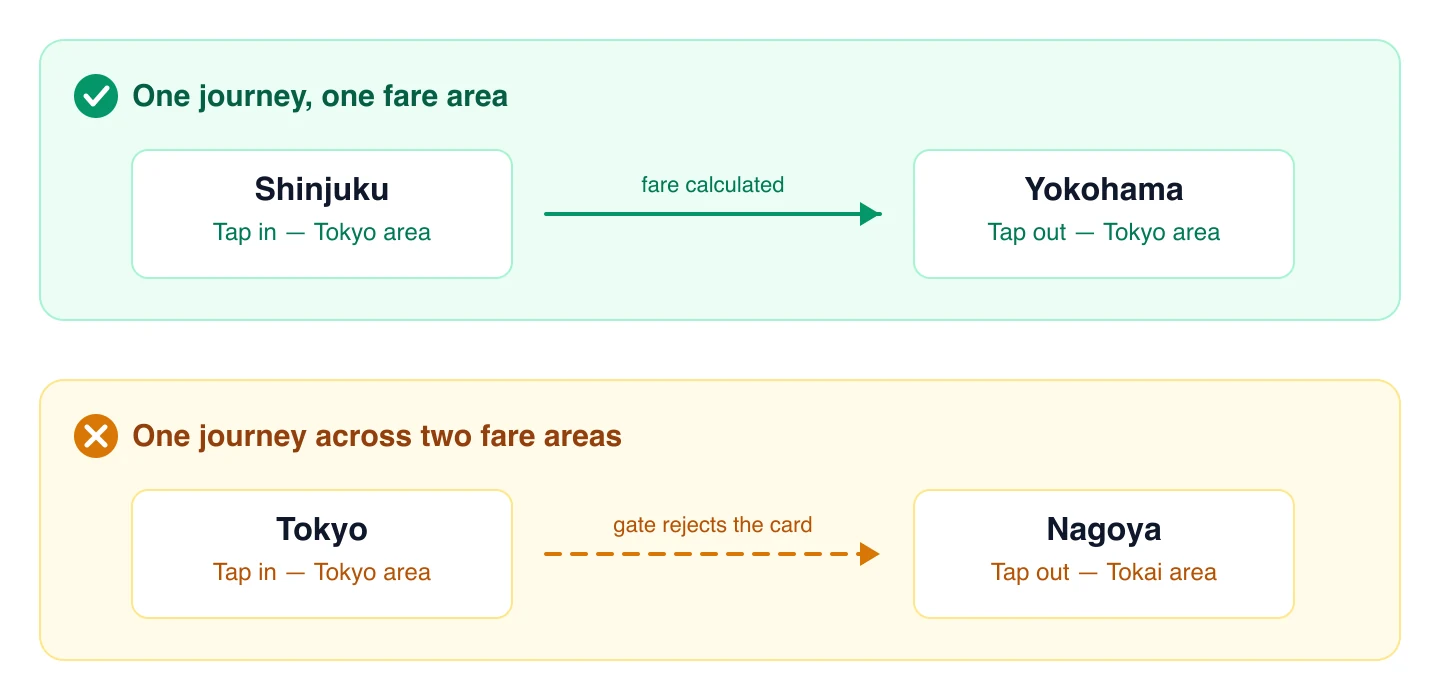
In practice this bites only on long intercity journeys — precisely the ones you would take on a Shinkansen or a limited express, which need their own ticket anyway. Riding all day in Tokyo, or carrying a Tokyo-bought card to Kyoto and using it there, is entirely normal.
Two smaller gaps are worth knowing. Some rural buses and local railways never joined the mutual-use scheme at all, and a few areas run their own local cards outside the ten. Where a route does not take IC, the vehicle or station says so, and you pay cash.
Where to buy one
Physical cards are sold at:
- Ticket machines in JR and subway stations — the usual route. Switch the machine to English first; the button is normally top-right on the screen.
- Staffed ticket offices, including JR East's midori no madoguchi (みどりの窓口). Necessary for children's cards and for registering a card in your name.
- Airport stations, which is the natural place to buy one, since the train into the city is your first journey anyway.
A standard card carries a ¥500 refundable deposit on top of the value you load. The deposit is not a fee — it comes back when you return the card.
Check what is on sale when you arrive
Which cards are available has changed more than once in recent years, and operators have at times restricted sales of anonymous cards while keeping the visitor versions on sale. Rather than committing to a specific card before you fly, see what the airport counter is selling — or sidestep the question entirely by adding a card to your phone, which is never affected by physical card supply.
Travelling with children
Children's fares are roughly half the adult fare, and a child's card must be issued at a staffed counter with proof of age. An adult card used by a child simply charges the adult fare, so the detour to the ticket office is worth it for anything longer than a day or two.
How to recharge
Topping up is called chāji (チャージ), and a card holds a maximum of ¥20,000.
Find a machine or a till
Any station ticket machine, the fare adjustment machines beside the gates, or the register at a convenience store. For mobile cards, top up in the app.
Insert the card, then the cash
On a ticket machine, choose "charge" and insert the card first. At a convenience store, hand over the card and say "chāji".
Check the new balance
The machine prints or displays it, and every ticket gate shows the remaining balance as you tap through.
Physical cards are topped up with cash, at machines and at convenience store tills alike. Cards inside a phone are the exception: those are recharged with a registered card in the app.
For a first load, ¥2,000–3,000 covers a few days of city travel, and adding more takes seconds at any station.
Mobile IC cards
Putting a card in your phone removes the deposit, the ticket machine queue, and the need to carry cash to top up. Where your hardware supports it, it is the better option — and it is worth setting up before you fly rather than on arrival.
Apple Wallet
Any iPhone 7 or later can hold a Suica, PASMO or ICOCA, regardless of which country the phone was bought in — Apple builds FeliCa support into every model worldwide. Add the card in the Wallet app, top it up with a payment card, and hold the phone near the reader. Express Transit means you do not need to unlock the phone or authenticate at the gate. Apple Watch works the same way.
Google Wallet
Android is the harder case. A Japanese transit card needs Osaifu-Keitai — Japanese FeliCa hardware — and the large majority of Android phones sold outside Japan do not have it, including flagship models that handle contactless payment perfectly well elsewhere. Having NFC is not enough; FeliCa is a separate radio protocol.
If your handset was bought in Japan, mobile Suica and mobile PASMO work well through Google Wallet and the operators' own apps. Otherwise, plan on a physical card.
Top-ups from a foreign card can be refused
Recharging a mobile card with a non-Japanese payment card works for many travellers and fails for others, depending on the issuer. It is not something you can reliably test before arriving, so carry enough cash for at least one recharge until you have confirmed yours is accepted.
Refunds and your deposit
Physical cards can be handed back for a refund of the remaining balance plus the ¥500 deposit — with two conditions that decide whether it is worth doing.
- Only the issuing operator can refund its own card. A Suica goes back to JR East, an ICOCA to JR West. A card bought in Tokyo cannot be returned in Osaka, so if your trip ends in a different region from where it started, refunding is not an option.
- A handling fee is deducted from the balance, not from the deposit. Return a card with a large balance and you lose a fixed amount; return one with an empty balance and you get the deposit back in full.
The practical consequence: spend the balance down rather than queueing for a refund. Buy your last coffee, your airport train ticket, and a snack with it. There is no fee on spending, and a card kept in a drawer is also a card ready for your next trip — balances do not expire for ten years.
Welcome Suica and the other tourist cards cannot be refunded at all, which is the trade you accepted for skipping the deposit.
Common mistakes
Assuming the card covers long-distance travel. It covers local networks. Shinkansen and limited express services need separate tickets, and starting the journey on balance alone leaves you stuck at the far-end gate.
Crossing a regional boundary in one journey. The card working in two cities does not mean it works between them.
Buying a physical card when a phone would do. iPhone users in particular queue for a card they never needed.
Sharing one card between two people. The gate records an open journey against the card, so the second tap-in is refused.
Expecting a refund anywhere. Refunds are handled by the issuing operator only — plan to spend the balance instead.
Leaving an anonymous card unregistered. A registered card can be cancelled and reissued with its balance if lost; an unregistered one cannot. Registration takes a couple of minutes at a machine and needs a name and phone number.
Forgetting to tap out. The system charges a maximum fare or flags an incomplete journey that staff then have to clear. Always tap on the way out, even when the gate is standing open.
Keeping two IC cards together. Two cards in one wallet confuse the reader, which sees both and accepts neither. The same applies to a card held against a phone that also holds one.
Reading the machines and signs
Every ticket machine has an English button, usually top-right on the touch screen, and it changes the whole interface — press it before anything else.
Some things stay Japanese regardless, and a few are worth recognising on sight rather than translating:
| On the machine or sign | Means |
|---|---|
| チャージ | Charge — top up the balance |
| 精算 / 精算機 | Fare adjustment, and the machine that does it |
| きっぷ / 切符 | Ticket |
| 残高 | Remaining balance |
| 入場 / 出場 | Entry / exit, shown on a gate display |
| 払いもどし | Refund |
Station names on the fare maps above the machines are written in kanji, usually with a smaller kana reading beside them and the romanised name underneath — so you can match the name on your route without reading the characters. If a machine ever leaves you stuck, the staffed gate at the end of the barrier line is the fastest route out; the attendant handles fare adjustments and card problems all day.
Is it worth it for a short trip?
Yes — even for a few days. Paper tickets mean reading a fare table in Japanese, working out the price to your destination before you buy, and repeating it for every leg. The card removes that decision entirely, works across operators without your knowing where one network ends and the next begins, and pays for your coffee afterwards.
The only case for skipping it is a trip made almost entirely of long-distance rail on a pass, with very little local travel at either end — and even then, most travellers end up wanting one for the subway.
More guides for getting around are collected under transportation, alongside the rest of the visitor guides.